Category: Chronic Foot and Ankle Pain

  • Cortrophin vs. Prednisone: A New Option for Treating Foot and Ankle Inflammation

    Foot and ankle pain is one of the most common reasons patients seek medical care. While injuries and overuse can certainly cause discomfort, many cases of persistent pain are actually driven by inflammation. Conditions such as rheumatoid arthritis, gout, and autoimmune tendon disorders frequently affect the joints and tendons of the feet.

    For decades, medications like Prednisone have played a major role in reducing inflammation. However, another therapy—Purified Cortrophin Gel—is increasingly being discussed as an alternative approach for certain patients.

    Understanding how these medications work can help patients better understand their treatment options.

    Why Inflammation Causes Foot and Ankle Pain

    The foot contains more than thirty joints and numerous tendons that allow for complex movement and balance. When inflammation affects these structures, swelling and pain can quickly interfere with walking.

    Several medical conditions commonly cause inflammatory foot and ankle pain.

    Rheumatoid arthritis is an autoimmune disease in which the immune system attacks joint tissue. The small joints of the feet are often among the first areas affected. Patients may experience stiffness in the morning, swelling around the toes, and progressive deformity over time if the disease is not controlled.

    Gout is another common inflammatory condition. It occurs when uric acid crystals accumulate within a joint. The big toe joint is especially vulnerable, and attacks often develop suddenly with intense pain, redness, and swelling.

    Inflammatory tendon disorders can also develop in the foot and ankle. Tendons such as the Achilles tendon and posterior tibial tendon can become inflamed due to autoimmune disease or chronic irritation.

    Because these conditions involve the immune system, medications that control inflammation are often a central part of treatment.

    The History of Corticotropin Therapy

    Before modern steroid medications were widely available, doctors relied on hormones produced naturally by the body to control inflammation.

    In the late 1940s, groundbreaking research led by Philip S. Hench demonstrated that adrenal hormones could dramatically reduce inflammation in patients with rheumatoid arthritis. This discovery revolutionized the treatment of inflammatory disease and contributed to the awarding of the Nobel Prize in Physiology or Medicine.

    Soon afterward, pharmaceutical companies developed synthetic corticosteroids that could be taken as pills. Prednisone became one of the most widely prescribed anti-inflammatory medications in the world because it was inexpensive and easy to use.

    As a result, corticotropin therapies gradually became less common.

    Today, however, new research into immune pathways has renewed interest in these medications.

    How Prednisone Reduces Inflammation

    Prednisone works by mimicking cortisol, a hormone naturally produced by the adrenal glands. It suppresses immune activity and blocks inflammatory chemicals throughout the body.

    Doctors frequently prescribe prednisone to treat:

    • rheumatoid arthritis flare-ups

    • severe gout attacks

    • autoimmune inflammatory diseases

    • allergic and inflammatory conditions

    While prednisone can be highly effective, long-term use may cause side effects such as elevated blood sugar, fluid retention, weight gain, and bone thinning. Because of this, physicians often aim to use the lowest effective dose for the shortest period possible.

    How Cortrophin Works

    Purified Cortrophin Gel works through a different biological pathway. The medication contains adrenocorticotropic hormone, or ACTH. This hormone stimulates the adrenal glands to produce natural steroid hormones such as cortisol.

    In addition to stimulating cortisol production, ACTH activates receptors within the immune system called melanocortin receptors. These receptors influence inflammatory signaling and immune cell activity.

    Because of these combined effects, Cortrophin may regulate inflammation in a broader way than traditional steroid medications.

    When Cortrophin May Be Considered

    Although prednisone remains widely used, Cortrophin may be considered in certain situations.

    Patients with rheumatoid arthritis affecting the feet may sometimes benefit from this therapy when other medications are not effective or tolerated.

    It has also been used to help manage severe gout attacks, particularly in patients who cannot take standard medications because of kidney disease or medication interactions.

    In rare cases, inflammatory tendon disorders linked to autoimmune disease may also respond to treatments that regulate systemic inflammation.

    Because Cortrophin is given as an injection rather than a pill, it is typically used under medical supervision as part of a comprehensive treatment plan.

    Comprehensive Treatment for Foot and Ankle Inflammation

    Medications are only one part of treating inflammatory foot conditions.

    Foot and ankle specialists often recommend additional treatments such as supportive footwear, custom orthotics, physical therapy, and activity modification. In advanced cases of arthritis or structural deformity, surgical procedures may also be considered.

    By combining medical therapies with biomechanical treatment strategies, many patients can significantly reduce pain and maintain mobility.

    The Future of Inflammation Treatment

    Medical research continues to improve our understanding of how the immune system drives inflammatory disease. While prednisone remains a cornerstone of treatment, therapies such as Purified Cortrophin Gel demonstrate how older medications may have new applications as scientific knowledge evolves.

    For patients living with chronic inflammatory conditions affecting the feet and ankles, advances in treatment offer hope for better pain control and improved quality of life.

    Dr. Philip Wrotslavsky is a foot and ankle specialist dedicated to diagnosing and treating conditions that affect mobility and quality of life. With extensive experience managing inflammatory disorders, arthritis, tendon injuries, and complex foot pain, Dr. Philip Wrotslavsky focuses on comprehensive treatment strategies that help patients return to comfortable movement and daily activity. Through patient education and advanced medical therapies, Dr. Philip Wrotslavsky works to provide personalized care for both common and complex foot and ankle conditions.

  • 3D Scanners and Custom Orthotics

    Traditionally custom orthotics were made using a plaster slipper cast technique. This involved using wet plaster to mold the shape of a person’s foot and then using the mold (slipper cast) to create a replica of the patient’s foot which was then used to make the orthotic. As time went on, the Foam Box technique became more popular which involved a practitioner positioning the foot in a particular way and then pushing the patient’s foot into a foam box which would create an imprint of the patient’s foot. Both techniques are used by orthotists and podiatrists today however, 3D scanning has started to become more and more popular.

    Benefits of 3D Scanning

    While 3D scanning and printing are newer technologies, further development has allowed it to become more widespread in the creation of orthotics. As this is a relatively new method, research is limited and there is no consensus when comparing the various methods. Anecdotally, 3D scanning is significantly quicker, more efficient, and less prone to error. The scans we take can capture the most subtle differences in the architecture of a patient’s foot down to the location of superficial veins on their feet. There is a significant decrease in delay in ordering the orthotics, and risk of misplacing an order or having it lost in transition is minimal. It is also more environmentally friendly as everything is digital which allows us to greatly reduces our carbon footprint. All while maintaining the same accurate measurements.

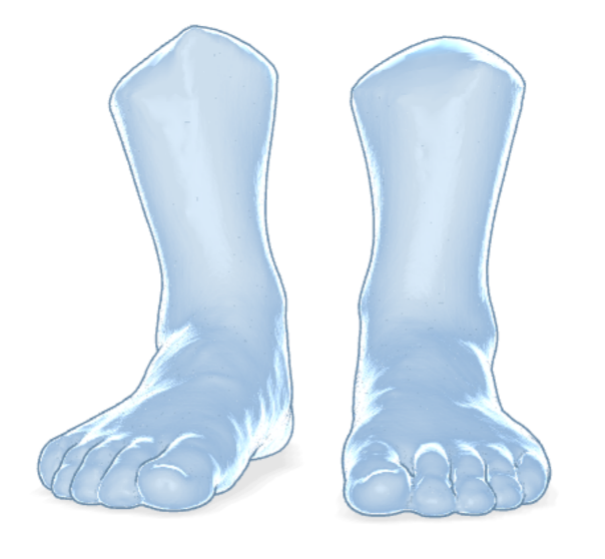
    Figure 1: A Feet Scan
    Figure 2: An Example of Custom Modified Orthotics Using our ARIZE 3D Scanner

    The Process:

    The ARIZE 3D Scanner allows us to take the most accurate digital scan of the feet and ankles and design your orthotics with you. With the accompanying program, we can add a myriad of customization options that will assist in compensating for deformities and relieving pain down to the millimeter and degree. During your visit we can show you what your orthotic device will look like and answer any questions you might have about what different additions will do for you. The scans are then sent to the manufacturer and your devices are 3D printed and delivered back to the office within 1-2 weeks.

    This has become a powerful tool in our practice that allows us to provide premium orthotics that greatly benefits our patients. Of course, orthotics are only good as the physical and biomechanical exam that precedes them. If you are having foot pain such as heel pain, arch pain , ankle sprains and pain in the ball of the foot that will benefit from orthotics, please don’t hesitate to make an appointment!


    Written by Dr. Gavin Tsuchida

    Dr. Tsuchida recently moved to San Diego from New York and is enjoying the beach and hiking when he’s not providing thoughtful, personalized care for his patients.

  • Chronic Pain of the Foot and Ankle


    Suffering from chronic pain of the foot and ankle requires a multimodality approach.  One can get chronic pain in the foot and ankle for many reasons such as CRPS otherwise known as complex regional pain syndrome, or after trauma or multiple fractures, and also after surgeries 1 can develop chronic foot and ankle pain.  With our increased knowledge in pain management therapies is imperative that we think beyond just the opioid treatments.  Is well-known that opioid treatments with medications such as Percocet and oxycodone can have addictive properties as well as issues with sleep and also when one becomes dependent on these medications the efficacy wears off.  It is important to realize that there are other treatments besides pharmacological treatments and taking pills.

    Over the last few years, there have been introduced to the market as a method of pain management the concept of implantable nerve stimulators.  These were devices that were originally approved for implantation in the back by the spinal column in order to address the pain at the level of the nerve where is exiting the spinal Column.  The name of this treatment is called peripheral nerve stimulation otherwise known as PNS.  The idea of peripheral nerve stimulation has been around since the 1960s, it was in 2012 that there were a number of devices that were introduced to the market that were just approved for spinal implantation.  Currently, there is available on the market a product by stim wave that can be implanted around the nerves of the foot without the need to implant a battery into the foot.  The way this works is that a very small tiny wire is implanted under the skin next to the nerve that is affected and causing the pain.  The way that you get the pain relief is once the small wire that is implanted under the skin is inserted, it becomes activated by an outside activation source that you as the patient can control.  This electrical signal will block the pain messages that are getting sent to the brain from the nerve.  You may feel a small tingling sensation that over time will block the pain and overtime reduce the pain to the point where you will not need to be dependent on pain medications. This is done as a trial prior to permanent implantation.  The trial is run for a week and if you do well with it then there can be a permanent implantation done at that time.  The way this works on a nerve level is the year is an electrode that delivers rapid electrical pulses to the nerve which is actually controlled by the patient to the level that the patient likes in order to get the results that they are looking for.  This is not a TENS unit it works in a very different way TENS units are applied onto the skin this is applied right against the nerve.  As well it uses a different electrical pulse in order to help relieve the nerve.  The main indication is for treatment of chronic pain.  Types of chronic pain in the foot can be from posttraumatic pain, pain from multiple surgeries, complex regional pain syndrome, and diabetic peripheral neuropathy.  However, it is not just limited to the symptoms but these are the most common symptoms.

    Stimwave’s StimQ Peripheral Nerve Stimulator System (PNS) utilizes the same technology as the Freedom SCS System. A neurostimulator with electrodes and a receiver to utilize wireless RF power is placed near a peripheral nerve in your body, below the head, to treat your chronic pain. Fitting through a needle-sized incision allows for placement with minimally invasive surgery, typically as an outpatient procedure.  Once implanted you CAN go into an MRI machine if needed for something else.

    Before the device is implanted permanently, there is typically a trial period to determine if the therapy is effective for your chronic pain. PNS is covered by most insurance plans.

    If you are interested in looking for an option that can help you with pain control for chronic foot and ankle pain consider the Stimwave’s StimQ Peripheral Nerve Stimulator System. We offer this treatment at the Advanced Foot and Ankle Center of San Diego. Make an appointment today to help ease your foot and ankle pain.