
Advanced Foot and Ankle Center of San Diego

Tag: lateral ankle instability

  • Ankle Sprains

    Ankle Sprains

    Sprained ankle, how about if you sprain your ankle multiple times a year. Are you one of the millions of people that suffer with multiple ankle sprains and chronic ankle instability. Do you wonder why whenever you are about to go out on a hike you are afraid to roll the ankle. Many ankle sprains and other ankle injuries can get better on their own or with physical therapy. There are times you will need a brace to stabilize the ankle. Unfortunately there are people out there that have not gotten relief from those methods and continue to roll their ankle. I have developed advances in surgical stabilization of the ankle via a minimal incision approach. This allows for the patient to recover faster and easier.

    It is vital for a patient to have the proper workup to evaluate the extent of the ligament damage. Ankle Range of motion, inversion , eversion , anterior draw sign are important parts of the physical exam. Radio graphic exams should include the typical 3 views of the ankle but should also include a stress inversion view. The stress inversion view can be better than an MRI. As it can tell you if the ligament is functioning. Just because an MRI says the ligament is intact it does not mean that it works. In a stress inversion view the tibio talar joint should not make an angle of greater the 5-7 degrees.

    31 degrees tibio talar opening ankle stress inversion X ray
    Ankle stress inversion view

    Here at the Advanced Foot And Ankle Center Of San Diego we have developed surgical techniques that fix the issue using grafts that stabilize the ankle and allows for full function. Most importantly we use minimally invasive approaches that allows for quicker recovery.

    Ankle Stabilization surgery

    If you are suffering with multiple ankle sprains or ankle instability , make an appointment today. We treat anyone from professional athletes to your weekend warrior.

  • Early Detection Of Charcot Foot

    Early detection of charcot foot has been something that has been vexing doctors for a long time. Charcot foot usually presents as a warm swollen foot. The patient feels as if they may have sprained a ligament . They are not feeling sick. Most doctors when presented with a red hot foot think infection , and the patient gets started on antibiotics. Antibiotics do not do anything for charcot foot.

    Charcot foot
    Charcot foot

    The charcot foot and ankle MUST be immobilized and put in a position where no weight can be put on it. One can have a total contact cast applied or an external fixator put on in order to prevent further breakdown of the foot or ankle. On a cellular level there is a lot happening where there is resorption of bone and weakening of ligaments. At this time there are no accepted blood tests or x rays that can confirm whether one is undergoing a charcot process. I am on a committee that consists of a group of international surgeons that treat charcot, there was a consensus that diagnosis of this condition is based on doctor expertise. To often doctors are unwilling to admit they do not know what is going on with the patient and they fail to refer out the patient to someone who is knowledgeable in charcot foot.  by then it can be too late . the foot will lose its structure, then you are left with a large deformity.  These large foot deformities result in extra pressures from displaced bones. Then the patient will require a different type of surgery to correct the deformity and get rid of any current infections.

    A common story that I deal with  is a patient will come in with a wound on the bottom of the foot and they will say the foot gave out a few months ago and then they developed a wound. X rays will show a big deformity. Good news is that with special surgical procedures available these conditions can be fixed.

    So if you need a San Diego charcot foot doctor you have come to the right place , please call for an appointment now.

  • Lateral Ankle Instability part two

    Lateral Ankle Instability part two

    Lateral Ankle instability part two. It’s been a few months and you keep spraining your ankle, you have tried a brace and even a custom brace. Now you are very frustrated and want to know your options. First thing is get a thorough exam. Is there a positive anterior draw sign. Is there excessive inversion of the ankle. Where x rays taken to rule out stress fractures and osteochondral defects. There is a special X ray technique that we perform called the stress inversion x ray exam this exam is quite helpful in telling us if there are ankle ligament tears. Next is an MRI. MRI’s are very helpful in letting you know if there are tears, However it is my experience not to fully rely on MRI’s for they can be wrong many times. I have had many patients that have had severe instability  with multiple sprains a week that had an MRI read as an intact ligament , but opted for surgery due to the major instability. What do you know, when I opened the area where the ligament was supposed to be there were none. Other things to be aware of are 2 conditions . One- torn peroneal tendons which can contribute to instability. It is important to repair torn peroneal tendons in order to maintain normal foot and ankle function. Also the position of your heel can contribute to ankle instability. It is called a varus positioned heel. If one has such a heel all the ligament repairs in the world won’t help because the stresses of the heel will re tear the ligaments. In those unique cases the heel bone needs to be re aligned into a proper position in order to obtain proper function. I have seen too many cases of ligament repairs gone bad because of other issues that were not identified .

    this is a letter from a patient of mine that had sustained a ligament tear while on the job fighting fires. ” Dear Dr Wrotslavsky  Thank you for fixing my ankle . After I tore my ankle ligaments I thought my career as a firefighter was over. I needed my ankles to work in order to go down steep slopes while fighting fires. I was also so worried because I loved to play basketball on the weekend and I could not after the ankle ligament tear. Thank you for Taking the time to carefully look over my MRI and explain everything in depth what was needed to be done surgically to fix it. I now have a very stable ankle for over a year and have not felt any pain and I am able to perform my job as a firefighter. and I can also play ball on the weekends. Thank you Dr Wrotslavsky   S.B. San Diego California

    Lateral Ankle instability part two

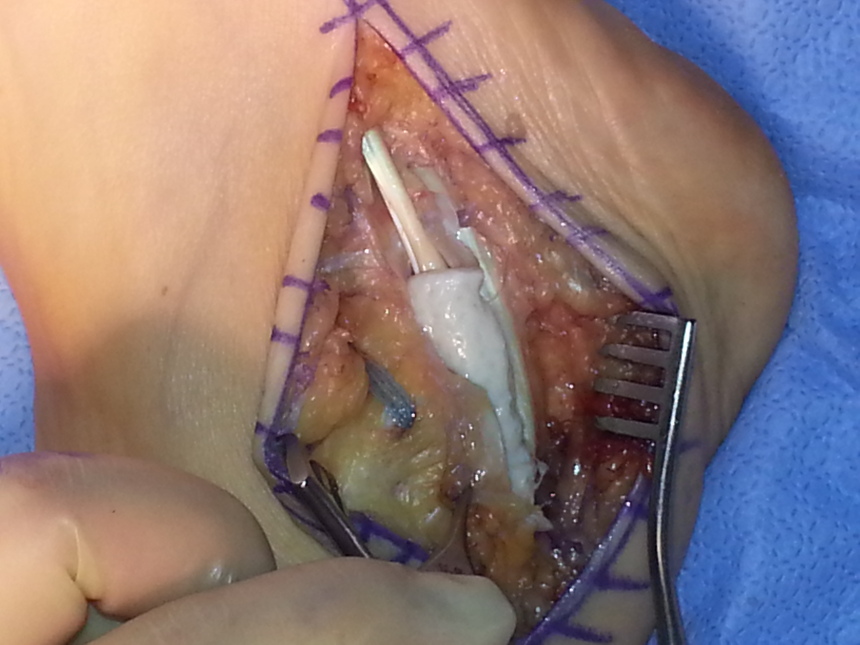
    below is a picture of a ankle ligament repair due to Lateral ankle instability along with a peroneal tendon repair using the internal brace technique

    peroneal tendon wrap with ATFL repair
    peroneal tendon wrap with ATFL repair