Advanced Foot And Ankle Center of San Diego seal of approval A shoe insole product that practically eliminates slippage and friction inside shoes, thereby preventing pain and injury. Lockdown Insoles are unique in the shoe and insole marketplace, and were invented and designed for: COMPETITIVE ATHLETICS HIKERS / WALKERS DIABETES FOOT ISSUES ALL SPORTS Feet slippage inside your shoes (micro-slippage) while walking, hiking, or playing sports causes you to waste energy, create heat/friction, and experience toe pain & injury. Lockdown Insoles were designed to solve these problems by securing your feet with unshakable grip, cushion, and energy return. With thousands of soft, grippy nodules on each insole, Lockdown Insoles can eliminate BRUISED & BLACKENED TOES BLISTERS & SKIN TEARS PAIN & SWELLING OTHER FOOT INJURIES https://www.lockdowninsoles.com/ Blisters on the feet after sports are a common occurrence and can be caused by various factors. Here are some possible causes: 1. Friction: Friction is one of the leading causes of blisters. When your foot repeatedly rubs against the inside of your shoe or against another surface, it can cause irritation and lead to the formation of blisters. 2. Ill-fitting footwear: Wearing shoes that are too tight or too loose can contribute to the development of blisters. Tight shoes can create pressure points and rub against the skin, while loose shoes can cause excessive friction and movement of the foot within the shoe. 3. Moisture: Moisture, such as sweat or wet conditions, can soften the skin and make it more susceptible to blister formation. Damp feet can also increase friction inside the shoe, leading to blisters. 4. Heat: Engaging in sports activities in hot weather or on hot surfaces can cause increased heat and moisture buildup in the shoes, which can contribute to blister formation. 5. Skin conditions: Certain skin conditions, such as athlete’s foot or eczema, can make the skin more vulnerable to blistering. These conditions can weaken the skin’s protective barrier and increase the risk of blisters. 6. Improper socks: Wearing socks that are too thin or made of non-breathable materials can exacerbate friction and increase the likelihood of blisters. It is important to wear moisture-wicking socks that provide cushioning and help reduce friction. 7. Overuse or sudden increase in activity: Engaging in sports or physical activities for extended periods or suddenly increasing the intensity or duration of exercise can put extra stress on your feet, leading to blisters. Blisters can lead to infections. To prevent blisters, it is advisable to wear properly fitting shoes, use moisture-wicking socks, keep your feet clean and dry, and apply lubricants or protective padding to areas prone to blistering. If blisters do occur, it is best to avoid popping them to reduce the risk of infection.
Blog
-
Levana Allograft Adipose Matrix Injections:
An Innovative Solution for Fat Pad Atrophy and Heel Pain Have you ever experienced severe foot pain by the ball of your foot or heel pain when standing or walking for extended periods? If so, you may have fat pad atrophy, a condition where the fatty tissue on the bottom of your foot wears away, causing discomfort and pain. While this condition can be caused by aging or excessive pressure on the feet, it can be challenging to find effective treatment options. Fortunately, a new solution has emerged in the form of Levana allograft adipose matrix injections. Levana allograft adipose matrix is a unique injectable solution that contains donated human adipose tissue. The tissue is processed to remove cells and preserve the extracellular matrix, which contains a complex mixture of proteins and growth factors. This matrix is then injected into the affected area to stimulate tissue growth and regeneration. One of the primary advantages of Levana injections is that they are minimally invasive and can be performed in an outpatient setting. The injections are typically administered under local anesthesia, and the entire procedure takes less than a half hour. After the injection, patients can typically resume their normal activities within a day or two (depending on the area that was injected). Levana injections have been shown to be effective in treating a variety of foot conditions, including fat pad atrophy of the foot and heel pain. The adipose matrix helps to restore the natural cushioning of the foot, reducing pain and discomfort. In addition, the growth factors in the matrix can promote tissue regeneration, helping to restore damaged tissues and prevent further degeneration. Clinical studies have demonstrated the safety and effectiveness of Levana injections. One study evaluated the use of Levana injections in patients with plantar fasciitis, a common cause of heel pain. The study found that patients experienced a significant reduction in pain and improved function after the injection, with no significant adverse events reported. Another study evaluated the use of Levana injections in patients with diabetic foot ulcers, a condition that can be difficult to treat due to poor circulation and impaired wound healing. The study found that Levana injections significantly improved wound healing and reduced the risk of infection, with no adverse events reported. In conclusion, Levana allograft adipose matrix injections offer a promising new solution for patients suffering from foot conditions such as fat pad atrophy and heel pain. These injections are safe, effective, and minimally invasive, making them an attractive option for patients who have not responded to other treatment options. If you are experiencing foot pain or discomfort, make an appointment today for an evaluation at the Advanced Foot And Ankle Center of San Diego
-

Richie Brace For Drop Foot
Drop foot, also known as foot drop, is a condition where the individual is unable to lift their foot upward. This may result in difficulty in walking or tripping while walking. Common causes of drop foot include nerve damage, muscle weakness, and conditions that affect the brain or spinal cord such as multiple sclerosis, stroke, and cerebral palsy. Injuries to the knee, hip, and ankle joints can also lead to drop foot.
One of the most effective treatment options for drop foot is the use of ankle-foot orthosis (AFO). The Richie Brace is a type of AFO that is designed to provide support and stability to the foot and ankle while allowing for normal movement. The brace is custom-made to fit the individual’s foot and ankle, and it consists of a plastic shell that wraps around the calf and foot, and straps that secure it in place.
The Richie Brace works by providing support to the foot and ankle, which helps to prevent the foot from dropping down. It also allows for normal movement of the foot and ankle, which helps to improve walking ability. The brace is designed to fit inside most shoes, allowing individuals to wear their regular footwear.
In addition to providing support and stability, the Richie Brace can also help to reduce pain and discomfort associated with drop foot. By providing a secure and stable base for the foot, the brace can reduce the amount of stress placed on the foot and ankle, which can help to alleviate pain and discomfort.

Richie brace Lacrosse Drop foot
Photo Credit Dean Wakeham, DWake95 Sports https://sports.dwake95.comOverall, the Richie Brace is an effective treatment option for drop foot that provides support, stability, and pain relief. It is important to consult with a healthcare professional to determine if the Richie Brace is the right treatment option for your specific condition. Here at the Advanced Foot And Ankle Center Of San Diego, we have over 15 years of experience in treating drop foot successfully with a custom-tailored treatment for you.

Richie brace Lacrosse Drop foot
Photo Credit Dean Wakeham, DWake95 Sports https://sports.dwake95.comThis is a patient of ours that needed a Richie Brace and is able to participate in sports again.
Richie brace Lacrosse Drop foot
Photo Credit Dean Wakeham, DWake95 Sports https://sports.dwake95.com -

The Cost of Custom Orthotics
The Cost of Painless Walking is $2
A friend and I were discussing orthotics the other day and we were talking about the price of custom orthotics. Especially in today’s economy with every subsequent article talking about rising inflation rates, the negative performance of the stock market, and an ever-increasing risk of recession that may or may not be worse than 2008, the price of everything comes to the forefront. Typically, custom orthotics cost 100’s of dollars. I could wax on and on about why a custom orthotic is better than a store-bought $40-$100 orthotic. However I’d like to share what my friend said.
He told me there is a saying that simply says to:
“Invest good money in anything that separates you from the ground”
Your chair, Your bed, Your shoes, Your tires, etc. These things are necessities in everyday life. A deficient or broken product usually leads to a significant disruption in daily living. The most common example is your mattress. The benefits of a good night’s sleep are well documented. It is standard advice to invest in a good mattress that will meet your sleep hygiene needs to get much-needed rest so that you can be at your peak performance the next day. Skimping and buying something subpar usually results in a disruption in sleep, a decrease in performance the next day, and the eventual purchase of another mattress quite a bit sooner than you would have otherwise.
Applied to orthotics, he quoted the often cited “10k steps a day” statistic. It is a commonly accepted belief in the modern day that 10,000 steps a day is a relatively good measure of a healthier active lifestyle. While there is debate about to its accuracy, for simplicity’s sake, let’s assume it is true. If you take 10,000 steps a day, that means you use both feet at least 10,000 times a day. Thus, you take 3,650,000 steps in a year. If you need orthotics, that means you will be using them at least 3.6 million times a year. For $650 that comes out to about

which can also roughly be expressed as $2 a day to walk painlessly. However, that assumes the custom orthotic only lasts for 1 year. The average custom orthotic usually will last at least 5-10 years depending on the amount of use. Even then, it will usually just need to be refurbished, not made from scratch (a significantly cheaper process). The math at that point becomes about $1 for 56,000 steps or about $1 for a little under a week’s worth of painless walking. Either way, the question is, is that worth it? To need a custom orthotic, there must be a foot and ankle issue that is causing a disruption large enough to go to a podiatrist’s office to seek help. What could you do if that pain wasn’t there anymore? How much is walking painlessly worth to you? It’s a personal decision, especially in today’s economy. But, again, I think it’s wise advice to keep in mind. Invest good money in anything that separates you from the ground.
Written by Dr. Gavin Tsuchida
Dr. Tsuchida recently moved to San Diego from New York and is enjoying the beach and hiking when he’s not providing thoughtful, personalized care for his patients.
-
Store Purchased Orthotics vs Custom
Retail vs Custom Orthotics
At their core, orthotics are devices that are placed in shoes to change how your feet meet the ground during weight-bearing. There are many different modifications that can be added and many different materials that are used to make a pair of orthotics for different purposes. As a result of this diversity and flexibility, it has become a powerful solution we as podiatrists are able to offer our patients to get them back to full activity and reduce their foot pain. But what’s the difference between a custom orthotic and a store-bought one?
Over-the-Counter Orthotics:
Affordable and Do the Job…Sometimes
It is true that most people would benefit from a supportive orthotic in their shoes.

However, it is also common for patients to come to the office with a bag of different store-bought orthotics that did nothing to aid their self-diagnosed cause of foot pain. An over-the-counter orthotic can, at times, be the perfect solution for patients that only require a little bit more arch support (e.g., plantar fasciitis). The problem is that not all brands of orthotics provide enough support, if at all. There is also the case where there is an additional deformity or other undiagnosed causes of foot pain. A retail orthotic is usually unable to offer anything but arch support unless modifications are made to it. Customizing a retail orthotic is possible, but usually, the modifications are temporary and often done with sticky felt that lasts for 1-2 weeks at most. However, they remain an attractive option because they are relatively affordable and work in a limited capacity.
Pros Cons · Cheaper · Limited modification ability · Gives support (sometimes) and/or cushioning · Substantial difference between brands · Can’t correct underlying deformity Custom Orthotics:
A Lasting Device Tailored to You
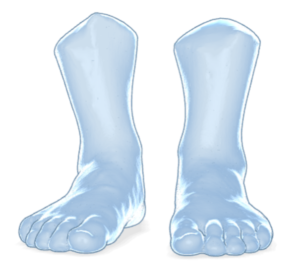
3-D Digital scan Custom orthotics are just that, custom. They can be modified to fit into any type of shoe, and specific materials are chosen to meet a patient’s comfort and needs. They are molded via different techniques to your specific foot and modifications are added for a patient’s specific biomechanical needs down to the millimeter. Often, they are used to add support or decrease pressure at specific points to relieve pain. They can be used to rebalance a leg length discrepancy to prevent compensatory pain at the knee/hips/back or can be used to reduce motion at joints to prevent arthritic pain. This is all based on a comprehensive lower extremity physical exam and gait analysis allowing us to evaluate the different deformities or biomechanical tendencies of each patient to create a truly patient-tailored device.
The Cost: An Investment into a Healthy Lifestyle
 Everyone wants to be healthy given the choice. However, foot conditions can cause a significant roadblock to an active lifestyle, a necessity for overall health. It becomes a self-defeating cycle. You want to be healthy so you try to exercise, but then you develop foot/ankle pain and you can’t walk, let alone exercise. When the solution is a custom orthotic, there is a price attached. However, it must be viewed as an investment into a pain-free active lifestyle and means to living a long and healthy life. Just as you buy a gym membership or home exercise equipment (weights, stationary bikes, etc.) for hundreds to thousands of dollars, a custom orthotic is a tool to get you healthy, active, and back to the pain-free daily life you deserve.
Written by Dr. Gavin Tsuchida
Dr. Tsuchida recently moved to San Diego from New York and is enjoying the beach and hiking when he’s not providing thoughtful, personalized care for his patients.
-
Foot Infection Antibiotic discussion Kimyrsa
Next up is KIMYRSA. KIMYRSA is a new IV antibiotic with similar uses as Dalvance: treating acute bacterial skin and skin structure infections with antibacterial properties against a similar spectrum of aerobic Gram-positive bacteria. It is the second generation of this specific antibiotic, the first being Orbactiv. It is from the same family of antibiotics as Vancomycin , however it has a significantly better safety profile and does not require and IV hanging out of your arm/
Why I Like it:
- Three Mechanisms of Action vs One: KIMYRSA is a lipoglycopeptide that acts in 3 different ways to kill bacteria. For those of you who are interested in more specifics, here is a video off their website that explains it.
- 1 Dose for 14 days of treatment: Like Dalvance, KIMYRSA also requires only 1 dose for 14 days of treatment. The benefits of which I discuss in the previous post (hyperlink to Dalvance post).
- Minimal Risk to Kidneys: One of the risks of long-term antibiotics, especially in cases of chronic/recurring infection and complex systemic infections with multiple sources where multiple antibiotics or rounds of antibiotics are required, is developing acute kidney injury (AKI). However, from the research that has been performed to date, KIMYRSA is not metabolized in the liver or kidneys but is instead excreted unchanged in urine and feces over time. As such, it does not need to be dose adjusted for renal impairment because it does not involve the kidneys at all, minimizing risk of developing AKI with use. In at risk patients or patients with chronic kidney disease, this is a very promising option.
As I discussed in a previous post, antibiotics are complicated. Not every antibiotic is ideal for every patient’s particular circumstances. But, for the right patient, I’m excited about KIMYRSA and what it can offer for treatment for patients.
*I have no financial interest in Melinta Therapeutics
Written by Dr. Gavin Tsuchida
Dr. Tsuchida recently moved to San Diego from New York and is enjoying the beach and hiking when he’s not providing thoughtful, personalized care for his patients.
- Three Mechanisms of Action vs One: KIMYRSA is a lipoglycopeptide that acts in 3 different ways to kill bacteria. For those of you who are interested in more specifics, here is a video off their website that explains it.
-
Foot infection Antibiotic Highlight: Part I – Dalvance
I wanted to discuss a few newer antibiotics that we’ve been using at Advanced Foot and Ankle Center of San Diego that we’re excited about. This is not intended to be extensive reviews of the pros and cons of each antibiotic but rather an introduction to and highlighting of the unique benefits they bring to patients. The first, is Dalvance.
Dalvance, or Dalbavancin, is a lipoglycopeptide that prevents cross-linking and thereby interferes with cell wall synthesis. It has been shown to be effective against aerobic Gram-positive bacteria which are commonly seen in diabetic foot wounds and post-op surgical site infections. Currently it is indicated for use in treating acute bacterial skin and skin structure infections. It has also been used more recently in my experience for osteomyelitis (off label use).
Why I Like It: 1 Dose for 14 days of treatment
 Dalvance’s largest advantage is that it only requires one dose. It is an IV antibiotic that stays in the blood at an appropriate concentration to work against bacteria for at least 14 days. This greatly simplifies treatment for a patient from a logistical standpoint while still providing optimal treatment.
Time is Precious!!
 IV antibiotics have 3 different ways it can be administered. Via home infusion (requires health aide or family member to administer), daily appointment at infusion center, or staying at an outpatient facility for treatment. Regardless of the method, there is a significant intrusion into daily life of both the patient and their loved ones. Time is required for infusion (can be up to 1 hour) and certain antibiotics can require administration up to 3 times a day. If you need to travel to an infusion center every day, that requires transportation time on top of the infusion time. Dalvance eliminates this as it requires only one 30min infusion that lasts for ~2 weeks which vastly reduces time and opportunity cost for patients while still delivering optimal treatment.
Of course, Dalvance cannot be prescribed for everyone. There are different factors that would make other antibiotics better for a patient. However, for patients that need an IV antibiotic for treatment of an infected diabetic wound or post-op surgical infection, I have found Dalvance to be a great option that gets good results without significantly impairing daily activity.
*I have no financial interest in Allergan Pharmaceuticals International or the parent company Abbvie Medical or Dalvance as a product
Written by Dr. Gavin Tsuchida
Dr. Tsuchida recently moved to San Diego from New York and is enjoying the beach and hiking when he’s not providing thoughtful, personalized care for his patients.
-
3D Scanners and Custom Orthotics
Traditionally custom orthotics were made using a plaster slipper cast technique. This involved using wet plaster to mold the shape of a person’s foot and then using the mold (slipper cast) to create a replica of the patient’s foot which was then used to make the orthotic. As time went on, the Foam Box technique became more popular which involved a practitioner positioning the foot in a particular way and then pushing the patient’s foot into a foam box which would create an imprint of the patient’s foot. Both techniques are used by orthotists and podiatrists today however, 3D scanning has started to become more and more popular.
Benefits of 3D Scanning
While 3D scanning and printing are newer technologies, further development has allowed it to become more widespread in the creation of orthotics. As this is a relatively new method, research is limited and there is no consensus when comparing the various methods. Anecdotally, 3D scanning is significantly quicker, more efficient, and less prone to error. The scans we take can capture the most subtle differences in the architecture of a patient’s foot down to the location of superficial veins on their feet. There is a significant decrease in delay in ordering the orthotics, and risk of misplacing an order or having it lost in transition is minimal. It is also more environmentally friendly as everything is digital which allows us to greatly reduces our carbon footprint. All while maintaining the same accurate measurements.
Figure 1: A Feet Scan 
Figure 2: An Example of Custom Modified Orthotics Using our ARIZE 3D Scanner The Process:
The ARIZE 3D Scanner allows us to take the most accurate digital scan of the feet and ankles and design your orthotics with you. With the accompanying program, we can add a myriad of customization options that will assist in compensating for deformities and relieving pain down to the millimeter and degree. During your visit we can show you what your orthotic device will look like and answer any questions you might have about what different additions will do for you. The scans are then sent to the manufacturer and your devices are 3D printed and delivered back to the office within 1-2 weeks.
This has become a powerful tool in our practice that allows us to provide premium orthotics that greatly benefits our patients. Of course, orthotics are only good as the physical and biomechanical exam that precedes them. If you are having foot pain such as heel pain, arch pain , ankle sprains and pain in the ball of the foot that will benefit from orthotics, please don’t hesitate to make an appointment!
Written by Dr. Gavin Tsuchida
Dr. Tsuchida recently moved to San Diego from New York and is enjoying the beach and hiking when he’s not providing thoughtful, personalized care for his patients.
-
Bathroom Toe Surgery Gone Wrong!
Bathroom Surgery Gone Wrong!
There is a colloquial term that we sometimes throw around called “bathroom surgery.” Typically, when we use common household items to perform procedures on ourselves that we think we can do with what we have lying around to avoid a trip to the doctor. In the podiatry world, it is arguably the most encountered when a patient has an ingrown nail.

This was the case for this unfortunate patient I saw years ago who had attempted to use a kitchen knife to take care of his own ingrown nail. He presented to the emergency room because he was having a fever and felt like his heart was beating too fast. He also noticed his left foot was turning red and swollen and the redness had been streaking up his ankle (a sign of a serious and progressing infection). After the initial workup by the Emergency docs, they called a sepsis code, and I was consulted to come to evaluate his foot. Long story short, this patient ended up staying in the hospital and requiring weeks of IV antibiotics. Luckily, he didn’t require surgery, and his infection eventually resolved. This is a rare and serious complication of an ingrown nail which can usually be treated the same day in the office with simple removal of the offending piece of nail.

The point of the story is that even for something as simple as an ingrown nail, complications are more likely to occur if the initial procedure is handled improperly. Household tools are often not as clean as we’d like to believe, and improper techniques or unnecessary procedures can lead to serious consequences. This is doubly so for patients with other medical conditions that could complicate healing or compromise their immune system. It is vital to seek the right help and not to wait until it’s serious.
If you have an ingrown nail or another urgent issue, please seek the appropriate care, and make an appointment. Especially for urgent issues, space can be made in the schedule so you can be seen the same day or the next day!
-
Cartilage Repair Painful Big Toe And Ankle
Are you experiencing
- Big Toe or Ankle Joint Pain?
- Stiffness or Reduced range of motion?
- Increased pain during cold, damp weather
- Difficulty moving the big toe up and down?
- Inflammation and swelling around the joint, especially the top?
- Pain that worsens with an increase in activity?
- Increased difficulty bending the toe?
- Inability to feel comfortable in shoes, particularly high heels for women?
- Pain and stiffness in the joint at the base of the big toe when walking, standing or bending?
- Have you been told you need a fusion or toe surgery?

S-Core subchondral solutions 
S-Core subchondral solutions 1st MPJ cartilage repair 
S-Core subchondral solutions osteochondral defect cartilage repair Subchondral Solutions S-Core® is novel device to restore the joint back to its original function and allow you to get back to your normal activity faster.
All Joints Are Not Created Equal
The S-Core® Platform utilizes a simple reproducible minimally invasive solution for a multitude of different joints including but not limited to the knee, ankle, toes, hand, wrist, shoulder, and elbow. The extremely strong time zero fixation allows you to return to normal activity in a fraction of the time compared to other procedures. Early range of motion has been shown to increase circulation, reduce stiffness, reduce swelling and reduce healing time.
The Procedure
Your joints are constantly in use and are often under a level of stress that can lead to pain from over-use and/or injury.
Over time stress can cause damage to the bone surrounding the injury. Think of this bone damage like a pothole in the road. If you delay fixing It the pothole will grow wider and deeper. When one has Cartilage damage such as an Osteochondral defect of the talus or head of the first metatarsal, the underlying bone disease needs to be addressed in order to repair the cartilage.
The S-Core® Procedure has been designed to reconstruct the foundation of the joint and repair fractures in the bone to help reduce or eliminate the pain and to return the joint to its bio-mechanical function. Similar to fixing a pothole. This allows for the cartilage graft over it to work.
Depending on the joint, the S-Core® implant can be used in both minimally invasive “arthroscopic” and open incisional procedures. The surgery takes 15-20 minutes and patients go home the same day.
The S-Core® implant has a multitude of unique features making it unlike anything on the market.
-Fenestrated: Allows for optimal blood flow through the implant supporting the bodies healing potential.
-Chambered: Minimal bone removal preserves pedicel of bone for additional surface area.
-Hydroxyapatite Coated: Improves Osteointegration.
The combination of these features and others stabilize the subchondral bone mechanically like rebar for concrete and the hydroxyapatite coating allows for the formation of new cartilage to grow over top.
Recovery
Patients typically delay or even avoid surgery due to the lengthy recovery time even when the pain persists. Delaying surgery will delay your recovery. Surgical procedures using S-Core® may help to reduce recovery time.
You are not alone. Big Toe Pain affects over 54% of people age 50 or older in the US annually. Schedule your consultation with Dr. Wrotslavsky today.
— At Advanced Foot & Ankle Center of San Diego, your team of highly experienced joint-care experts will help find your best path forward, whether that involves advanced pain-management therapies or leading-edge joint replacement as well as Cartilage repair.

S-Core subchondral solutions osteochondral defect cartilage repair


